第一作者:Lizhuang Dong
通讯作者:Udayabhaskararao Thumu
DOI:https://doi.org/10.1016/j.cej.2026.173817
本文针对无铅卤化物钙钛矿光催化CO₂还原中载流子复合严重、传统Type-I异质结电荷分离效率低的问题,提出了界面内建电场调控策略:将Cs₂CuBr₄纳米簇原位锚定在二维g-C₃N₄纳米片上,构筑准二维非经典Type-I异质结构。该结构通过界面内建电场诱导类Z-scheme电荷迁移,促进电子定向富集于g-C₃N₄表面,同时增强CO₂吸附/活化并降低COOH*中间体形成能垒,最终实现高效、高选择性CO₂光还原制CO。
2026年2月,Chemical Engineering Journal杂志在线发表了电子科技大学Udayabhaskararao Thumu教授团队在光催化CO₂领域的最新研究成果。该工作报道了界面内建电场调控策略,将传统上不利于电荷分离的Type-I异质结构转化为高效CO₂光还原体系,为无铅卤化物钙钛矿光催化剂设计提供新思路。论文第一作者为:Lizhuang Dong,论文通讯作者为:Udayabhaskararao Thumu。
在能源危机与碳减排需求日益突出的背景下,光催化CO₂还原被认为是一种利用太阳能实现碳资源转化的重要策略。卤化物钙钛矿具有良好的光吸收和载流子传输能力,但传统铅基体系存在毒性和稳定性问题,因此发展无铅钙钛矿光催化剂具有重要意义。
Cs₂CuBr₄作为铜基无铅卤化物钙钛矿,具有可见光响应和潜在的CO₂还原能力,但单一材料仍受限于载流子快速复合、CO₂吸附/活化能力不足等问题。异质结构筑是改善这些问题的有效方法,但传统Type-I异质结通常被认为不利于电荷分离。
本文的核心难点与创新点在于:作者通过将Cs₂CuBr₄纳米簇原位锚定在二维g-C₃N₄表面,构筑非经典Type-I异质结构,并利用界面内建电场诱导类Z-scheme电荷迁移,从而突破传统Type-I异质结的限制,实现高效、高选择性CO₂还原制CO。该研究为无铅钙钛矿光催化剂的界面设计和电荷调控提供了新的思路。
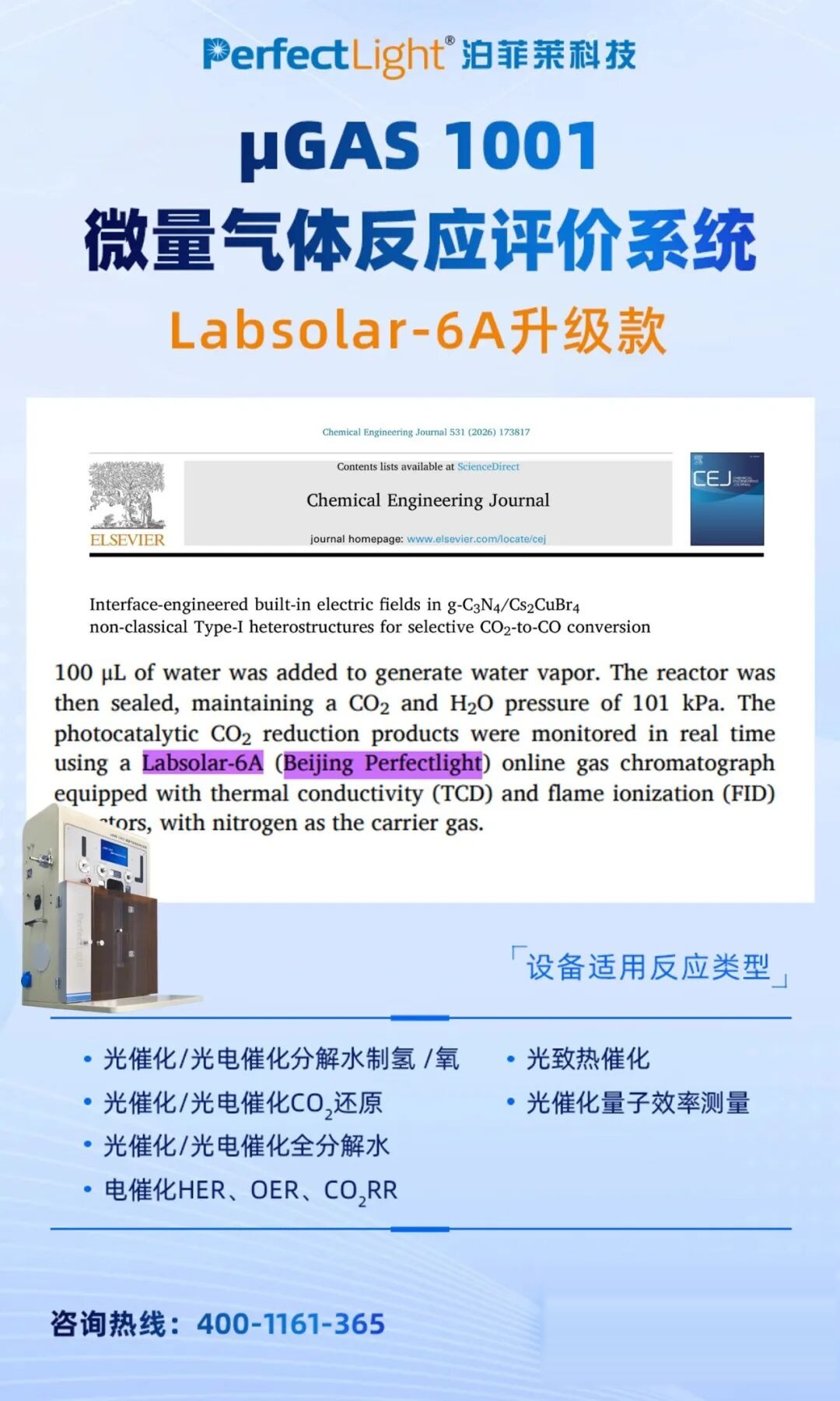
本文使用设备为泊菲莱μGAS1001微量气体反应评价系统的前代机型。μGAS1001微量气体反应评价系统是一款催化活性评价系统,适用于有微量气体产生的催化反应。如光催化全解水,光催化CO₂还原反应等。主体集成控制单元、气体循环模块、自动取进样模块和反应器模块。
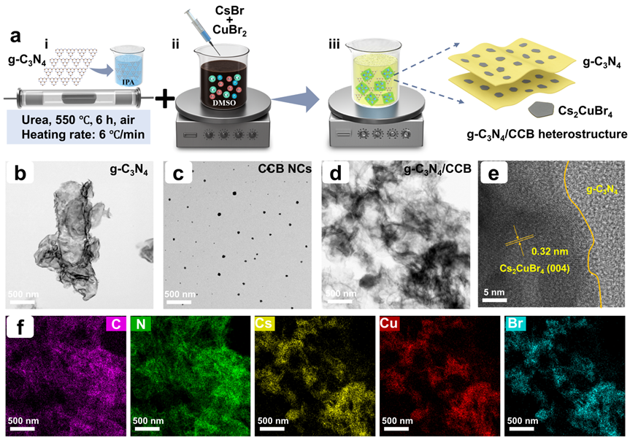
Figure 1. (a) Synthetic route of the g-C3N4/CCB heterostructure; Morphological and structural characterization: (b) TEM image of g-C3N4; (c) TEM images of CCB; (d) TEM images, (e) HRTEM image, and (f) EDX elemental mapping of the g-C3N4/CCB heterostructure, confirming uniform distribution of C, N, Cs, Cu, and Br.
要点:图1通过合成示意图、TEM/HRTEM和元素映射证明了CCB纳米簇均匀锚定在g-C₃N₄纳米片上,形成紧密耦合的准二维g-C₃N₄/CCB异质界面,为高效电荷分离和CO₂光还原奠定结构基础。
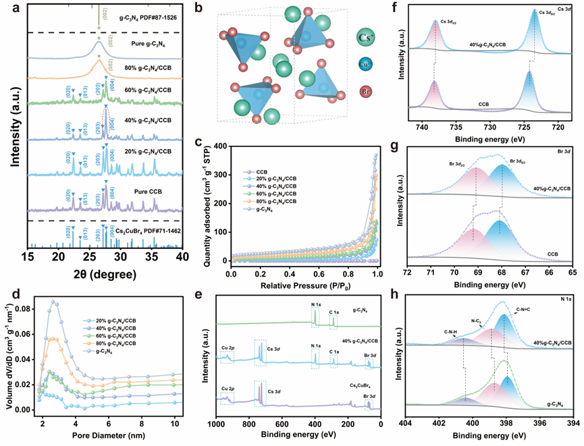
Figure 2. Structural and textural characterization: (a) XRD patterns of pristine g-C3N4, CCB, and g-C3N4/CCB heterostructures with varying g-C3N4 mass ratios; (b) CCB Crystal Structure Schematic; (c) N2 adsorption-desorption isotherms of g-C3N4, CCB, and g-C3N4/CCB heterostructures; (d) Pore size distribution curves of g-C3N4 and optimized g-C3N4/CCB heterostructure; X-ray photoelectron spectroscopy analysis: (e) Survey spectra of g-C3N4, CCB, and the g-C3N4/CCB heterostructure; High-resolution spectra of (f) Cs 3d, (g) Br 3d and (h) N 1s core levels in all samples.
要点:图2通过XRD、BET和XPS证明了g-C₃N₄/CCB异质结构的成功构筑,并揭示二者之间存在明显界面电子转移和内建电场形成,为高效光催化CO₂还原提供结构与电子基础。
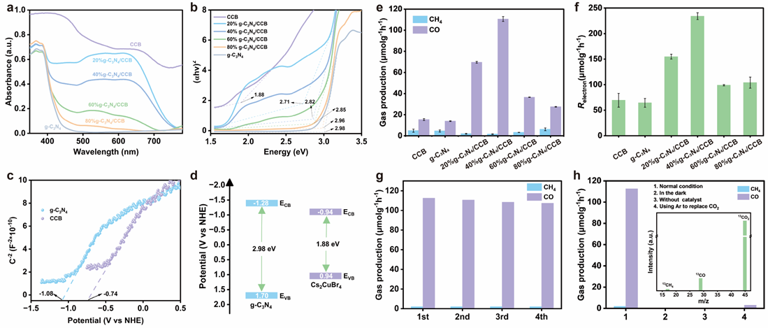
Figure 3. Optical and electronic properties: (a) UV-vis diffuse reflectance spectra and (b) Tauc plots of pristine g-C3N4, CCB, and g-C3N4/CCB heterostructures with varying CCB mass ratios; (c) Mott-Schottky plots of g-C3N4 and CCB; (d) Schematic band alignment diagram of g-C3N4 and CCB based on experimental data. Photocatalytic CO2 reduction performance: (e) Production yields of CO and CH4 for pristine g-C3N4, CCB, and g-C3N4/CCB heterostructures with varying CCB mass ratios; (f) Comparison of electron consumption rates (Relectron) across all samples; (g) Cyclic stability tests of the g-C3N4/CCB heterostructure over four consecutive runs; (h) Control experiments under different reaction conditions (dark, light-only, etc.) (Inset: Mass spectra for photocatalytic CO2 reduction over g-C3N4/CCB heterostructure using 13CO2).
要点:光学性质、能带结构与CO₂还原性能。
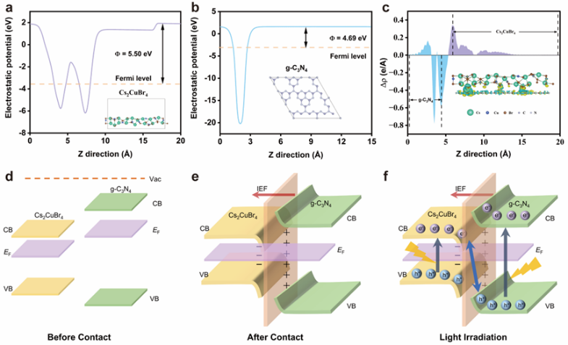
Figure 4. (a) Calculated work functions of CCB; (b) Calculated work functions of g-C3N4; (c) The planar-averaged charge density difference of the g-C3N4/CCB heterostructure, with an inset showing the side view; (d-f) Formation mechanism of Non-classical Type-I heterostructure photocatalyst: before contact (d), after contact (e) and under light irradiation (f).
要点:内建电场与非经典Type-I电荷转移机制。
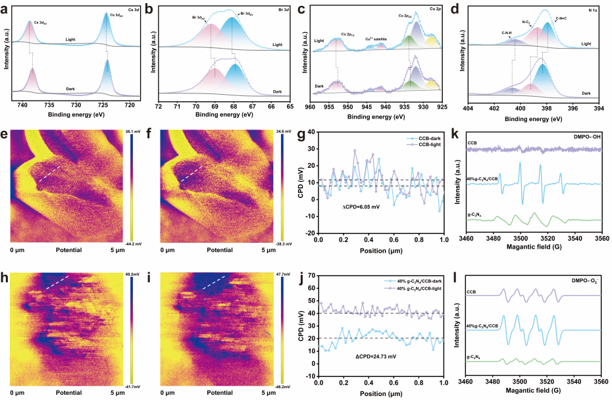
Figure 5. In situ XPS spectra of the g-C3N4/CCB heterostructure under dark and illuminated conditions: (a) Cs 3d, (b) Br 3d, (c) Cu 2p and (d) N 1s core levels. Surface potential and reactive species characterization: Surface potential distribution of (e, f) CCB and (h, i) g-C3N4/CCB heterostructure under dark and illuminated conditions (ΔCPD = CPDlight - CPDdark); Corresponding potential changes for the (g) CCB and (j) g-C3N4/CCB heterostructure; (k) ESR spectra of DMPO-·OH and (l) DMPO-·O2- adducts generated by pristine g-C3N4, CCB, and the g-C3N4/CCB heterostructure under light irradiation.
要点:实验验证电荷迁移方向和活性物种生成。
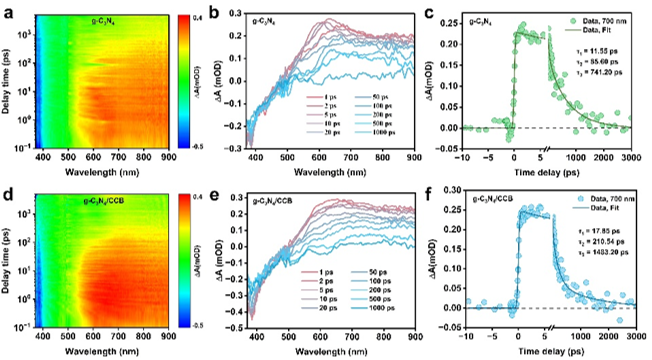
Figure 6. fs-TA characterization and kinetic analysis of g-C3N4 and g-C3N4/CCB. (a, d) TA contour maps; (b, e) selected TA spectra at different delay times; (c, f) normalized kinetic traces at 700 nm with tri-exponential fits.
要点:图6证明g-C₃N₄/CCB异质界面显著延长载流子寿命,为CO₂还原提供更多可用电子。
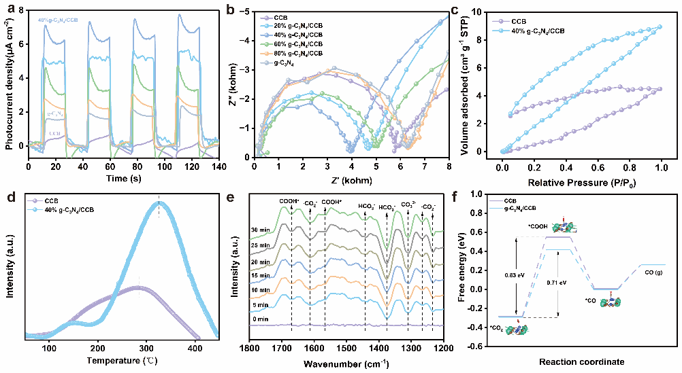
Figure 7. Charge transfer and CO2 adsorption properties: (a) Transient photocurrent responses and (b) electrochemical impedance spectra of pristine g-C3N4, CCB, and g-C3N4/CCB heterostructures with varying g-C3N4 mass ratios; (c) CO2 adsorption-desorption isotherms and (d) CO2 temperature-programmed desorption (CO2-TPD) profiles of CCB and the optimized g-C3N4/CCB. (e) In-situ DRIFTS spectra of CO2 interaction with g-C3N4/CCB under simulated sunlight irradiation at different time intervals; (f) Gibbs free energy diagrams of the main pathways for CO2 photoreduction over CCB and g-C3N4/CCB.
要点:CO₂吸附/活化能力与反应路径。
本文围绕无铅钙钛矿光催化CO₂还原中载流子复合严重、CO₂活化能力不足、Type-I异质结通常不利于电荷分离等问题,构筑了准二维 g-C₃N₄/Cs₂CuBr₄(CCB)非经典Type-I异质结构。通过将超细CCB纳米簇原位锚定在二维g-C₃N₄纳米片上,形成紧密耦合的界面结构,从而诱导强内建电场,促进光生电荷定向迁移和有效分离。证明了通过界面内建电场工程,可以突破传统Type-I异质结电荷分离效率低的限制,为无铅钙钛矿光催化CO₂还原材料设计提供了一种新的机制认识和结构设计策略。
Udayabhaskararao Thumu,电子科技大学教授。主要研究方向为:纳米化学;纳米自组装;原子级精确团簇;非线性光学。
国家青年千人,在Science,J. Am. Chem. Soc和Angew. Chem. Int. Ed等国际一流期刊上发表论文50余篇。
课题组链接:
https://www.iffs.uestc.edu.cn/info/1138/3292.htm
L. Dong, M.M. Rashidi, S. Kumar, H. Rokni, M. Piotrowski, C. Wang, A. Neogi, Z. Wang, U. Thumu, Interface-engineered built-in electric fields in g-C3N4/Cs2CuBr4 non-classical Type-I heterostructures for selective CO2-to-CO conversion, Chem. Eng. J. 531 (2026) 173817. https://doi.org/10.1016/j.cej.2026.173817

北京泊菲莱科技有限公司(Beijing Perfectlight)成立于2006年,是国家级高新技术企业、中关村高新技术企业及北京市第一批“专精特新”企业,企业通过 ISO 9001/14001/45001 管理体系认证,售后服务达 GB/T 27922-2011 五星级标准。公司专注于智能化、高精度、高性能设备及整体解决方案的研发、生产、销售与服务,产品涵盖光源、光/光电/光热/热催化装置、表征测试系统、产研装置与光合成设备等十余系列,支撑从基础研究、小试中试到工业化放大。泊菲莱面向高校、研究所及企业,重点服务新能源、药物合成、精细化工与新材料等领域;产品已进入 3000+ 实验室、远销近 50 个国家,累计支撑发表 SCI 论文 9000+ 篇。公司牵头或参与国家与行业标准制定,承担国家重点研发计划,拥有多项核心知识产权与“北京市新技术新产品”认证,并已助力多家企业用户建成吨级与百吨级光化学生产线。