要点:图2通过XRD、BET和XPS证明了g-C₃N₄/CCB异质结构的成功构筑,并揭示二者之间存在明显界面电子转移和内建电场形成,为高效光催化CO₂还原提供结构与电子基础。
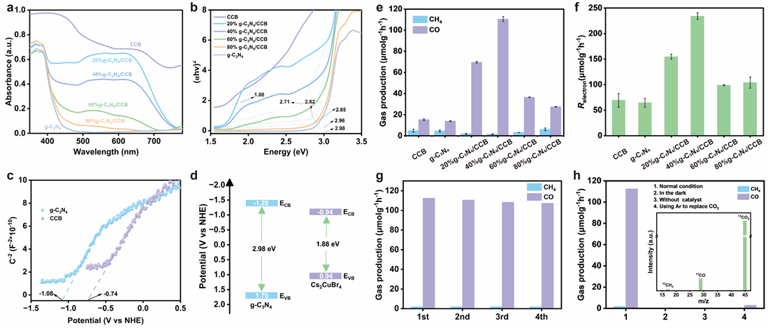
Figure 3. Optical and electronic properties: (a) UV-vis diffuse reflectance spectra and (b) Tauc plots of pristine g-C3N4, CCB, and g-C3N4/CCB heterostructures with varying CCB mass ratios; (c) Mott-Schottky plots of g-C3N4 and CCB; (d) Schematic band alignment diagram of g-C3N4 and CCB based on experimental data. Photocatalytic CO2 reduction performance: (e) Production yields of CO and CH4 for pristine g-C3N4, CCB, and g-C3N4/CCB heterostructures with varying CCB mass ratios; (f) Comparison of electron consumption rates (Relectron) across all samples; (g) Cyclic stability tests of the g-C3N4/CCB heterostructure over four consecutive runs; (h) Control experiments under different reaction conditions (dark, light-only, etc.) (Inset: Mass spectra for photocatalytic CO2 reduction over g-C3N4/CCB heterostructure using 13CO2).
要点:光学性质、能带结构与CO₂还原性能。
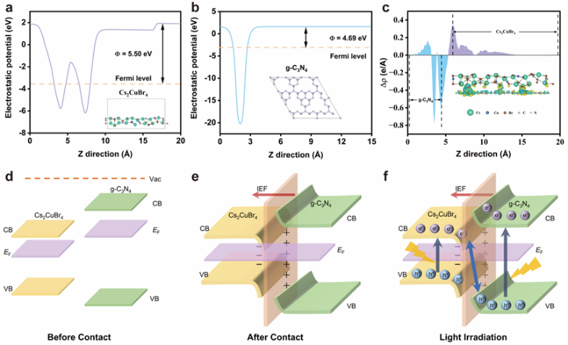
Figure 4. (a) Calculated work functions of CCB; (b) Calculated work functions of g-C3N4; (c) The planar-averaged charge density difference of the g-C3N4/CCB heterostructure, with an inset showing the side view; (d-f) Formation mechanism of Non-classical Type-I heterostructure photocatalyst: before contact (d), after contact (e) and under light irradiation (f).
要点:内建电场与非经典Type-I电荷转移机制。
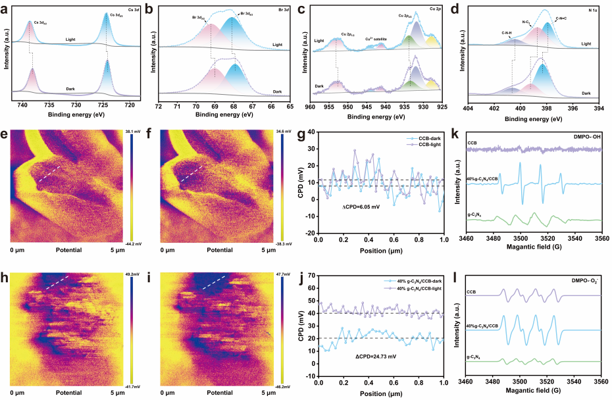
Figure 5. In situ XPS spectra of the g-C3N4/CCB heterostructure under dark and illuminated conditions: (a) Cs 3d, (b) Br 3d, (c) Cu 2p and (d) N 1s core levels. Surface potential and reactive species characterization: Surface potential distribution of (e, f) CCB and (h, i) g-C3N4/CCB heterostructure under dark and illuminated conditions (ΔCPD = CPDlight - CPDdark); Corresponding potential changes for the (g) CCB and (j) g-C3N4/CCB heterostructure; (k) ESR spectra of DMPO-·OH and (l) DMPO-·O2- adducts generated by pristine g-C3N4, CCB, and the g-C3N4/CCB heterostructure under light irradiation.
要点:实验验证电荷迁移方向和活性物种生成。
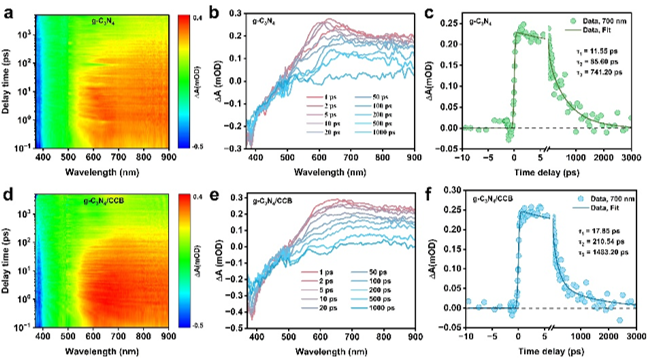
Figure 6. fs-TA characterization and kinetic analysis of g-C3N4 and g-C3N4/CCB. (a, d) TA contour maps; (b, e) selected TA spectra at different delay times; (c, f) normalized kinetic traces at 700 nm with tri-exponential fits.
要点:图6证明g-C₃N₄/CCB异质界面显著延长载流子寿命,为CO₂还原提供更多可用电子。
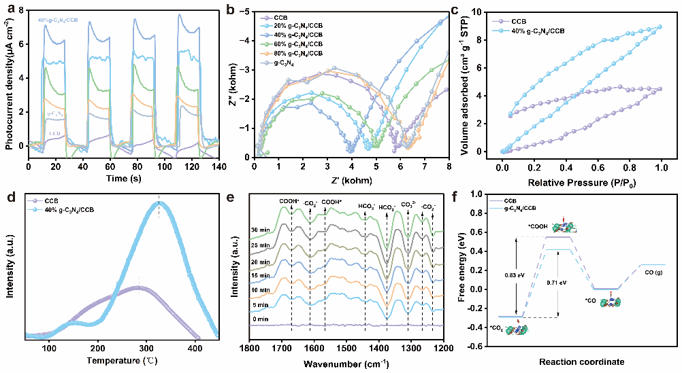
Figure 7. Charge transfer and CO2 adsorption properties: (a) Transient photocurrent responses and (b) electrochemical impedance spectra of pristine g-C3N4, CCB, and g-C3N4/CCB heterostructures with varying g-C3N4 mass ratios; (c) CO2 adsorption-desorption isotherms and (d) CO2 temperature-programmed desorption (CO2-TPD) profiles of CCB and the optimized g-C3N4/CCB. (e) In-situ DRIFTS spectra of CO2 interaction with g-C3N4/CCB under simulated sunlight irradiation at different time intervals; (f) Gibbs free energy diagrams of the main pathways for CO2 photoreduction over CCB and g-C3N4/CCB.
要点:CO₂吸附/活化能力与反应路径。
本文围绕无铅钙钛矿光催化CO₂还原中载流子复合严重、CO₂活化能力不足、Type-I异质结通常不利于电荷分离等问题,构筑了准二维 g-C₃N₄/Cs₂CuBr₄(CCB)非经典Type-I异质结构。通过将超细CCB纳米簇原位锚定在二维g-C₃N₄纳米片上,形成紧密耦合的界面结构,从而诱导强内建电场,促进光生电荷定向迁移和有效分离。证明了通过界面内建电场工程,可以突破传统Type-I异质结电荷分离效率低的限制,为无铅钙钛矿光催化CO₂还原材料设计提供了一种新的机制认识和结构设计策略。